Know whether you would pass, before exam day.
Answer questions weighted to the exam's own published syllabus and the drill projects your score, names the subjects costing you the most marks, and schedules what to review next.
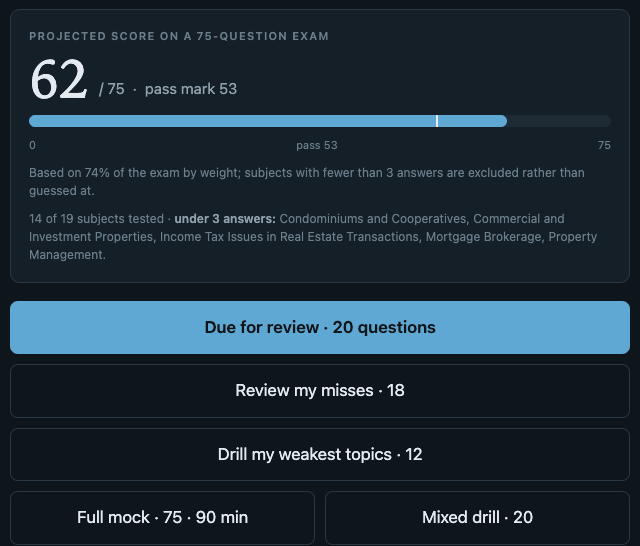
The drill after a fortnight of answering. Every figure on it is computed from what you got right.
What the drill does while you answer
- Projects your score. Every answer updates a projected result on the real exam, weighted by how much of the exam each subject is worth, with the subjects it has not measured named rather than glossed over.
- Ranks what is costing you most. Weak subjects are ordered by marks at risk, not by percentage wrong, so a shaky subject worth eight marks outranks a terrible one worth two.
- Runs the real thing. A full mock at the published length and clock, with a pace meter reading questions left against time left.
- Decides when to bring a question back. Spaced repetition schedules each item from how well and how recently you answered it, and pulls the intervals in as your exam date approaches.
- Reads aloud. Optional narration for studying while your eyes are somewhere else.
Why you can trust the answer
A projected score is only worth as much as the questions behind it.
Within the two-year period preceding renewal, how many hours of continuing education must a New York real estate licensee complete under RPL §441?
22.5 hours
That is a real question from the bank, with the statute text the build matched it against. The answer says 22.5 hours; the statute says twenty-two and one-half. A question that cannot be traced back to wording like that does not ship.
Most free practice banks will not tell you where an answer came from, and some are confidently wrong. Two of the ones a New York candidate finds first attribute licensing to a “New York Real Estate Commission.” No such body exists. Licensing sits with the Department of State’s Division of Licensing Services.
You cannot catch that while you are still learning the material. That is the whole problem, and it is why the checking here is done by a program rather than promised in a paragraph.
How the checking works
- Cited before it ships. A question resting on a statute or a clinical figure carries a quotation from its source, and the build rejects the question unless that quotation is found in the source character for character. A paraphrase fails.
- Read by a second pair of eyes. A citation proves a source exists, not that the question states it correctly. An independent review pass checks the substance, and every question shows which of the two checks it has had.
- Audit it yourself. Each drill publishes a sources page listing every work its questions draw on and the provenance of each question: salesperson sources · tobacco treatment sources.
Built so far
The engine takes any exam with a published blueprint. These two are built and live.
Yours, on your device
A drill runs entirely in your browser and keeps its history in local storage. It works with no account, and it keeps working offline once the page has loaded. Signing in is optional: it backs that history up so it survives a cleared browser and follows you between devices, and nothing about the drill changes if you never do.